News
- The deadline for registrations has been shifted to the 30st of June!
- The registration is open!
Lake Balaton
General Information
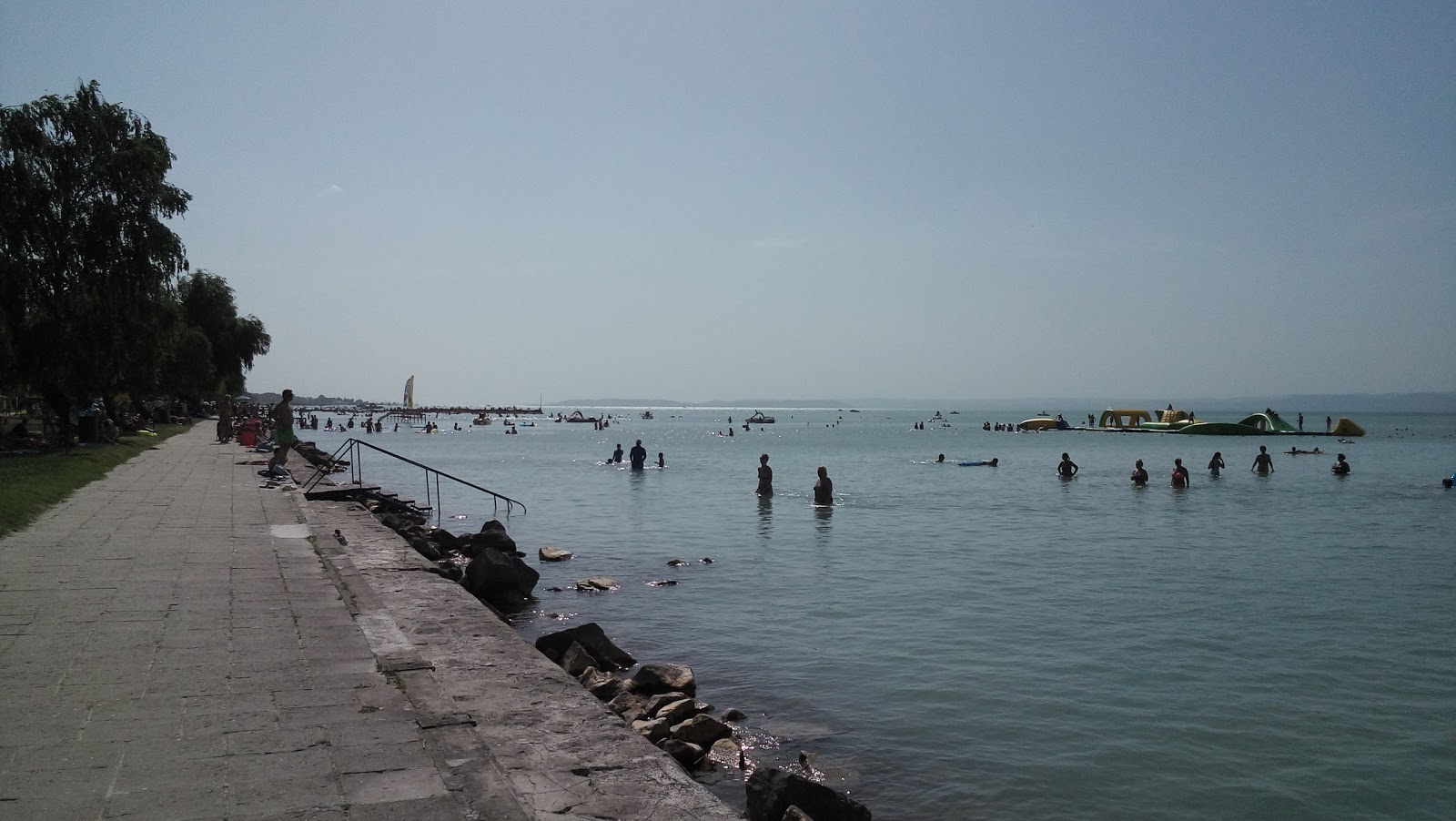
Lake Balaton is the largest lake in Central Europe, with a length of 77 km, and a breadth varying between 4 and 14 km. The water of Lake Balaton is most suitable for bathing in the three summer months. In this period its temperature is rarely less than 22 °C, and in high summer it is not unusual for it to reach 27-28 °C. Being a freshwater lake, it is ideal for bathing for those whose skin is sensitive to salt.
Shores
With respect to sunbathing, the northern and southern shores of Lake Balaton are strikingly different from one another. On the northern shore the water deepens sooner: 30-50 metres from shore it is deep enough to cover a person. The beaches here are recommended for good swimmers. The Szigetfürdő ("Island bath"), a successor of a former bathing house, in Keszthely is very pleasant, and fine beaches can also be found in Zánka, Tihany, and Balatonfüred. On the southern shore the water deepens very gradually, and in most places we can walk in up to five hundred metres without having to swim.
Kis-Balaton
The vast marshes of the Kis-Balaton at the western end of the lake were fortwenty thousand years the natural filter of the River Zala, which feeds Lake Balaton. Three generations ago the Zala was diverted to feed directly into Lake Balaton, whose healthy, clear water was consequently polluted and made muddy by the river for half a century. The problem was solved by a method adopted nowhere else in the world: by restoring conditions similar to the original marsh. The 20-square-kilometre reservoir, completed fifteen years ago, is now a nature conservation reserve, where once more birds flock in large numbers, just as they used to. One particularly charming part, the Kányavári Island, is open to the general public, for the pleasure of anglers and nature photographers. Travelling around the area of the Kis-Balaton the ecotourist comes across another site: the Kápolnapuszta Buffalo Reserve. Formerly these animals of fearsome strength were used for the heaviest work, but gradually more docile and versatile cattle took their place in agriculture. In Europe these grim-looking animals, descended from bison, can only be found in Kápolnapuszta and Transylvania.
Badacsony
Badacsony is the most famous wine-growing hill of the Balaton region. It is here that the grapes which go to making Badacsony Pinot Gris and Kéknyelű are grown. On the southern slope of the 437 m basalt hill hikers can sample the excellent restaurants and wine bars. At the summit the Kisfaludy Lookout offers a memorable panorama. Down below, not far from the harbour we find the house of József Egry, the painter of Lake Balaton, which is now a museum in his memory. The region hosts the Badacsony Vintage Days. Places of interest near Badacsony: the Szigliget Castle, Tapolca, the cave lake and the Mill Lake Szent György Hill, organ-pipe basalt formations.
Tihany
One of the most obvious points in the landscape of the northern shore, just as it is on the map, is the Tihany Peninsula. On the smaller hill, a church and monastery was built in Tihany nine centuries ago. The royal document ordering the construction, the Deed of Foundation of Tihany, contains the oldest words written in Hungarian in a Latin context. Today only the Romanesque crypt, supported by squat columns, can be seen, and above it a Baroque Abbey has been built. The entire area of the peninsula is protected, and special sights include the Inner Lake (good for fishing), the cones formed by geysers, the Aranyház and lavender fields. The museums of Tihany are: the Benedictine Abbey Museum, the Open Air Ethnographical Museum (peasant farm house and house of the fishermen's guild) and the Doll Museum.
The Wonders of Nature
Nature has bestowed beauty in plenty on Lake Balaton. Much of the outstanding landscape belongs to the protected area of the National Park of the Upper Balaton. Those interested can ask for an expert to guide them, and see the region's botanical and geological specialities on study trails and in displays. The most varied landscape rolls out from the Szépkilátó ("Fine Viewing Point") close to Balatongyörök - poets have sung its praises. The wonderful variety of the landscape of the volcanic northern shore is at its most beautiful seen from the Várhegy ("Castle Hill") in Fonyód or Balatonboglár.
Keszthely
Keszthely is the oldest of the towns around Lake Balaton. Many of its small streets faithfully preserve the small-town atmosphere of the 19th century. For centuries, a decisive factor in the development and culture of Keszthely was the presence of the Festetics family, one of the richest Hungarian aristocratic families. Their Baroque stately home, today a museum, is one of the finest monuments in the Balaton region. Each week in the summer concerts are held in the park and the splendid rooms. The Balaton Museum is also a delight: its dioramas and show cases present the formation of the lake, the natural world, archaeological finds, the region's folk culture, and the history of the bathing culture. The nave of the Roman Catholic church is from Medieval times, and the frescos are held to be the finest creations of Hungarian Gothic. The city hosts the summer Balaton Festival and the Balaton Autumn.
Hévíz
The most beautiful parts of the landscape around Lake Balaton were formed by volcanic action, and even 2.5 million years after the extinction of the volcanoes their effect, though tamed, can still be felt. Dozens of sulphuric and carbonated springs burst from the ground along the lakeside, and in most of them people have sought (and found) healing for centuries. The most famous is the spring at Hévíz, which breaks to the surface at the foothills of the Keszthely hills. This is actually a geyser whose crater lake creates a natural bath of therapeutic water at 38°C. Only in Iceland can anything similar be found. The sulphuric, mildly radioactive water of the Hévíz lake is just as excellent for the treatment of locomotor diseases as the mud from the bottom of the lake. The Hévíz lake is a sight to behold, particularly at the end of summer, when the red lilies from India flower in their thousands. Around the lake there are dozens of therapeutic hotels and sanatoriums.
Wine Guide
Wines were brought to the region two thousand years ago by the Romans. The soil and climate of the Balaton region favours this delicate plant, and now Lake Balaton has become almost synonymous with good wines. Badacsony wine is a veritable legend. The reason for the excellent quality is the soil, containing volcanic rock, the Mediterranean climate of the sheltered southern slope and what is known as secondary radiation, the sunlight reflected from Lake Balaton, which doubles the strength of the rays. The best known wines of the Badacsony region are Szürkebarát (Pinot Gris) and Kéknyelű, but the Olaszrizling (Laski Rizling), the Rizlingszilváni (Müller-Thurgau), the Ottonell Muskotály (Muscat Ottonel), and Tramini are also delicious. Many characteristics of the Balatonfüred-Csopak region are similar to those of Badacsony. Although the wines here are also fiery and strong, they have a more elegant character than those from the neighbouring region. The typical grapes of the region are the Rajnai Rizling (Rhein Riesling), Olaszrizling (Laski Riesling) and Chardonnay, but on the Tihany hills black grapes also grow: Merlot, Zweigelt and Cabernet Franc. Somló Hill is also a famous wine-growing region, if a little further from the lake. Its vintage was formerly known as the "wedding night wine", for it was widely believed that those who drink it give birth to baby boys. For centuries Somló wine was indispensable at royal wedding banquets. Today the side of the well- formed volcanic remnant hill is planted mainly with Furmint, Olaszrizling, but this is also the last bastion of an old Hungarian variety, Juhfark. A large area of the wine growing region next to Lake Balaton is encircled by the southern slopes of the Keszthely hills and the Káli Basin. Many varieties of white grapes grow in these parts, but the most famous is the locally selected Cserszegi fűszeres ("spicy wine of Cserszeg"), the wine of which, with its spicy bouquet and nose, has won a dozen or so competitions. Grapes have long been cultivated on the southern shore of Lake Balaton too. The varieties grown are no different from those on the other shore, but the sandy loess soil lends them an entirely different flavour. In these parts, the cellars mature smooth, fruity wines, rich in aromas. Perhaps the only exception are those grown on the side of Castle Hill in Fonyód and Balatonbolgár, because the two small hills - just like their larger brothers on the opposite shore - are also the result of volcanic activity. The largest single vineyards can be found on the border of Balatonboglár.